

Stop Losing Hoteliers at Hello: 3 Content Dos and Don’ts to Build Trust in Your Hotel Tech Solution
You can’t run. You can’t hide. AI jargon will find you, no matter where you go.
But too often it comes alone – without explanations, real use cases or proof.
And you’re left wondering what you just read.
Maybe you’re like me and your eyes are tired from all the rolling.
Then you probably scroll on or click back the moment you see another ad, article or LinkedIn post screaming about “revolutionary AI and industry-leading algorithms”.
What does that even mean? 
But jokes aside. What if your potential customer feels like that, too? What if they see content about your hotel tech solution and run for the hills?
Then it’s time for a hard look at how your content describes your technology.
Use the three DOs and DON’Ts in this article to build more trust in your hotel tech solution by telling them how it’ll make a real difference for them.
Key takeaways:
- Lead with outcomes, not AI labels. Hoteliers care about results like occupancy, efficiency and revenue, not technical specs or buzzwords.
- Transparency builds more trust than hype. Be upfront about how your solution works, its limitations, and where humans stay in control.
- Prove every claim. Real customer stories with honest numbers are far more convincing than polished, vague promises.
- Educate, don’t just sell. Content that explains AI concepts in plain, practical terms positions your brand as a trustworthy partner.
- Quality beats quantity. Generic AI-generated content is boring and erodes credibility. Original insights, real data, and specific use cases set you apart.
3 Dos that help you build trust in your hotel tech solution
You want hoteliers to stop in their tracks, explore your tech solution and hurry to book that demo. But they’re skeptical by nature.
Make your content tick the following three boxes to build trust more effectively.
| 1. Be transparent and realistic to win over skeptics | Honesty and detail will foster trust rather than hype and build your long-term credibility. |
| 2. Lead with outcomes, not algorithms – and support your claims | Speak to hoteliers’ goals, highlight real use cases and results and show proof for your claims. |
| 3. Be the helpful expert your (potential) clients need | Educate potential clients on AI-related concepts and translate what the technology is into what it does for a hotelier’s business. |
1. Be transparent and realistic to win over the skeptics
According to Hospitality Technology, 75% of travel and hospitality businesses now see AI as a strategic business driver. But many hoteliers are still not convinced when it comes to adopting it in their hotel tech. Some have been burned by unfulfilled promises, like the 56% who think AI tools lack accuracy. Others are just naturally skeptical.
Address this mindset proactively by being fully transparent:
- Outline how the system works and where humans stay in control
- Answer the question “What if the AI gets it wrong?”
- Describe what AI-failure looks like and how to handle it
- Set realistic expectations regarding results and requirements (e.g., our solution performs best with 12+ months of historical data)
- Be upfront about integration complexity, one of the biggest concerns for most hoteliers
This honesty and detail foster trust rather than hype. It also signals maturity and builds long-term credibility.
2. Lead with outcomes, not algorithms – and support your claims
Hotel tech buyers care about real results. GMs and revenue managers want higher occupancy and RevPAR. Front office and F&B managers look for increased operational efficiency and improved guest service. IT directors want easy integration with the existing tech stack, security and compliance.
Frame your solution’s capabilities in terms of those results.
Here’s an example:
Avoid harping on technical specs like “powered by an ML model” or “cognitive computing” (Does your reader even know what this means?).
Instead, talk about how your tech brings tangible results:
- Reduces unwanted overbookings by X%
- Detects up to 99% of rate disparity cases
- Saves X hours a week on manual data entry/answering repeat guest questions, etc.
- Increases ancillary revenue by up to X%
Put simply: Let the outcome do the selling.
Then prove your claims.
Highlight real customers (with their permission) and their results. Talk about roll-out, hiccups and success candidly to tell a story other hoteliers can relate to. These stories don’t have to be perfectly polished. Real use cases and imperfect numbers are far more believable and always beat vague promises.
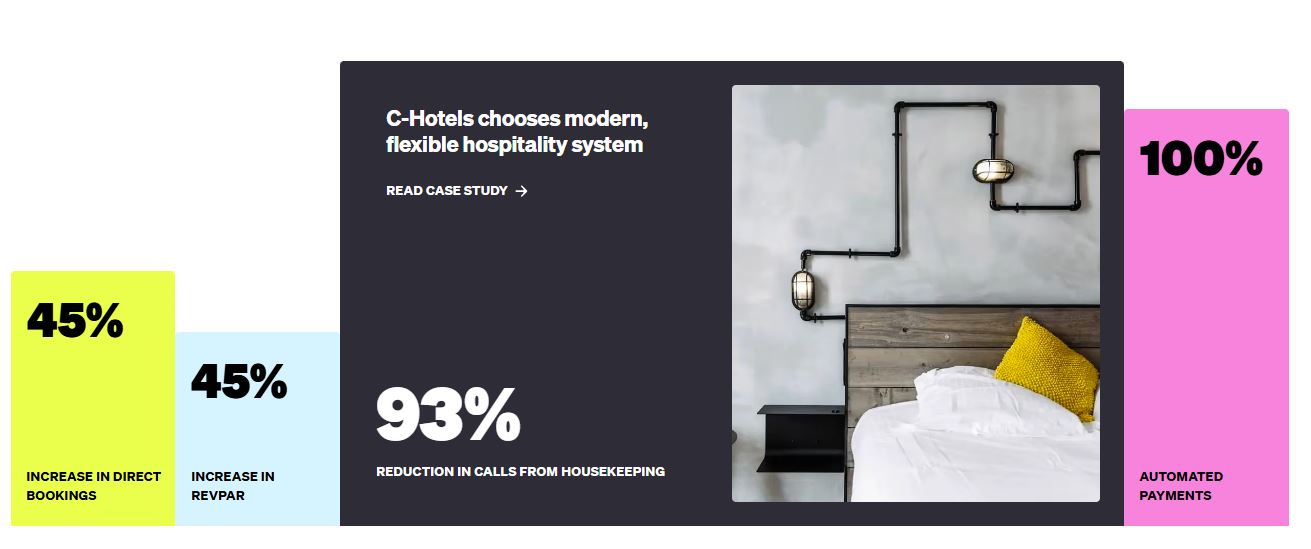
Here is screencapture from the Mews home page. They do a great job prominently highlighting the results existing clients get.
3. Be the helpful expert your (potential) clients need
Sure, everyone’s heard of AI by now. But real-life AI use cases may still be unfamiliar territory for some hoteliers. Content that explains AI-related concepts positions your brand as a trustworthy guide rather than just another tech vendor.
Depending on your solution, you could cover:
- How AI-supported dynamic pricing works in practice
- What AI-assisted upselling means for guests and teams
- How smart personalization looks in day-to-day operations
The key is translating what the technology is (e.g., an AI-assisted upselling tool) into what it does for a hotelier’s business. That helps readers picture a new workflow or outcome at their property.
Run this simple test to check if your content hits that mark:
Lastly, don’t forget about post-sale content.
Onboarding guides, “what to expect in month one/six/twelve”-content, and troubleshooting resources show that you’re a supportive partner, not just chasing the signature. This is especially important in a word-of-mouth-driven industry like hospitality.
3 Don’ts to avoid when marketing your hotel tech solution
You’ve worked hard to get your prospect’s attention and they’re warming up to you.
But in a market full of lofty promises, the wrong words can trigger their BS-detector and send them straight to your competitors.
You’ll avoid that by steering clear of the following three trust-killers.
| 1. Don’t slap the term “AI” on everything | Instead, talk specifically about what your tech solution does better, faster, or more reliably. |
| 2. Don’t focus on how AI will replace human staff | Instead, reframe your tool as an assistant that frees staff from repetitive tasks and lets them put their time to better use. |
| 3. Don’t rely on AI to market and sell your solution | Instead, focus on quality content over quantity and use social proof. |
1. Don’t slap the term “AI” on everything
Almost every hotel tech vendor claims to be using AI. But if your content leads with this label rather than the solution’s value, it fades into the noise.
Just think how often you’ve read phrases like “intelligent automation” or “next-gen AI platform” without an explanation. They always leave me thinking “So what?” with the obligatory eyeroll 🙄.
But in all seriousness, when used alone, these phrases are more likely to breed suspicion than excitement.
“When AI is mentioned, it tends to lower emotional trust, which in turn decreases purchase intentions,” says Mesut Cicek, lead author of a recent study by the Journal of Hospitality Marketing & Management. “We found emotional trust plays a critical role in how consumers perceive AI-powered products.”
What to do instead: Focus specifically on what your tech solution does better, faster, or more reliably.
Hoteliers deal with real, urgent challenges: staffing shortages, rising energy costs, demand volatility…. Content that connects your AI solution to those pressing problems is far more compelling than evergreen positioning statements.
Another note on hiding behind buzzwords and jargon: hoteliers are pragmatic. If they can’t picture how your tech will work at their property, they disengage. Plain language is a mighty trust signal here.
2. Don’t focus on how AI will replace human staff
Yes, the AHLA found that 65% of surveyed hotels struggle with staffing shortages. But a new report shows that implying AI will replace hotel staff creates resistance among the people who will champion (or block) your tool day-to-day.
What to do instead: Reframe your tool as an assistant that frees staff from repetitive tasks and lets them put their time to better use.
Sure, AI, automation and other smart technology can help teams work more efficiently. That’s the whole point. But as of now, tech solutions can’t fully replace entire staff members in a people-focused industry like hospitality.
(Zero-service or unmanned hotels could be the exception, but they’re not the point here.)
Highlight these points in your content instead:
- Which manual tasks get automated to make the workload easier to manage, e.g., guest profile updates in the PMS or rate shopping.
- How teams can respond faster to changing markets or last-minute guest demands, e.g., reacting instantly to shifts in booking pace or informing all involved teams of a recently-ordered welcome amenity.
- When your tool allows them to make better decisions faster, e.g., by suggesting tailored ancillary services to front desk agents during check-in.
Finally, stress that hoteliers can review, override, or fine-tune AI recommendations. This reassures hoteliers that they remain in control.
3. Don’t rely on AI to market and sell your solution
Tempting as it may be to scale content creation with AI tools, I recommend some restraint here. Hoteliers can spot surface-level, trend-chasing articles and are quick to click away. And even search engines aren’t fans of generic AI-Bla.
A recent SEMRUSH study found that content classified as purely AI-generated appeared in the top spot just 9% of the time. Human-written pieces were there 80% of the time.
What to do instead: Focus on quality content over quantity
Depth, specificity, and original data or perspectives build trust among hoteliers. It will also set you apart from the competition. Everyone can prompt an AI tool to write an article about today’s hot topic. And they’ll all sound the same.
But only you can share your founder’s inspiration behind the product, your CEO’s vision or your Head of Product’s new ideas.
Or why not discuss your own data and trends you’ve seen, like top upsell offers by target market or how booking windows change by source market and time of year?
Case studies are another powerful content type you can’t outsource to AI. Use stories from real clients that mirror your prospect’s situation and desired outcome.
If done right, you’re boosting your chances of winning a new client.
Conclusion: Building trust in hotel tech isn’t rocket science, but it does take discipline and know-how
Phew, that was a lot. So, let’s sum it up:
- Skip the buzzwords.
- Show real results.
- Be honest what your technology can and can’t do.
- Educate your audience instead of dazzling them with jargon.
- And when it comes to content, always choose depth over volume.
Do those things consistently, and you’ll stand out at a time when too many hotel tech vendors are shouting into the void.
I know that can feel daunting, especially with a million other things on your plate.
If you want help creating trust-building content for your hotel tech solution, from website copy to case studies and articles like this one, I’m here to help.
Drop me a message and let’s talk.
FAQ – More questions on building trust for your hotel tech solution
Q1: How do I make our AI features sound compelling without overusing buzzwords?
Focus on the specific problem your AI solves and the measurable outcome it delivers. Sure, you can say you provide “AI-powered revenue optimization”. Then add details and outcomes, like “automatically adjusts room rates based on real-time demand, reducing manual work for revenue managers by X hours a week.” Concrete, role-specific language always outperforms generic tech claims.
Q2: Our solution is genuinely complex. How much technical detail should our hotel tech marketing content include?
Match the depth to the audience. A blog post targeting GMs needs plain-language outcomes. A whitepaper for IT directors can go deeper into architecture and security. The key is to lead with the business benefit and layer in technical detail only where it adds credibility, not complexity. Ask yourself: Does my reader actually need to know this to say yes?
Q3: How do we build trust with hoteliers who’ve had bad experiences with previous tech vendors?
Acknowledge their skepticism head-on rather than ignoring it. Pretending it doesn’t exist will only make it worse. Case studies that honestly cover implementation challenges and how you resolved them work particularly well here. Transparency about limitations, realistic onboarding timelines, and post-sale support content all show that you’re a supportive long-term partner, not just chasing the deal.
Q4: How often should we publish content to stay credible and visible in the hotel tech space?
Consistency matters more than frequency. One well-researched, high-value article per month will do more for your credibility than four generic posts per week. Focus on content that answers hoteliers’ real questions. Then repurpose strong pieces across platforms. That could be as LinkedIn posts, newsletters or short videos. This extends their reach without diluting quality and gives your marketing team some room to breathe.
Q5: We want to use AI tools to help produce content. Is that a problem?
It doesn’t have to be. But use them as a starting point and an assistant, not a replacement for a skilled content writer or copywriter. AI tools can help with research, structure, and first drafts, but you need to add interesting insights, data, and points of view. Hoteliers are highly specialized and skilled. They’ll quickly spot content that lacks genuine industry knowledge. So always add a layer of human expertise, real customer experience, or original data before publishing. Otherwise, you’re doing exactly what Don’t #3 warns against.




Leave A Comment